Five years ago, a "luxury bathroom" in LA meant a freestanding tub, marble floors, and a chandelier. Today, the conversation has shifted entirely. The 2026 bathroom is about how the room feels. Temperature, light, sound, water pressure, scent. Not just what it looks like in photos.
That shift has implications for every decision you'll make. Steam showers are no longer rare. Wall-mounted faucets are everywhere. Large-format porcelain has nearly replaced traditional 12×12 tile. And homeowners are asking real questions about wellness, heated floors, towel warmers, integrated speakers, smart controls.
Here's what we're seeing show up in the bathrooms we're building across Los Angeles in 2026.
The Wellness Layout: Zones, Not Rooms
The biggest functional change is how we lay out bathrooms. The old model was: toilet, sink, tub, shower, all crammed into 60 square feet. The 2026 primary bathroom is bigger and divided into zones:
- A wet zone (steam shower + curbless drain + freestanding tub if there's room)
- A dry zone (vanity, mirror, lighting, makeup station)
- A water closet (toilet), separated by a door
- Sometimes a "transition" zone, a small bench, a place to sit and pull on shoes
This isn't about being precious. It's about how families actually use bathrooms, two people getting ready at the same time without colliding, kids brushing teeth while a parent showers, easier cleanup, calmer mornings.
Steam Showers: No Longer a "Nice to Have"
Five years ago, a steam shower was a luxury upgrade, a $4-7K add-on for clients who really wanted it. Today, it's becoming a default request in primary bathrooms. The reason: research on the wellness benefits has gone mainstream, and the technology is finally affordable and reliable.
What's involved in a steam shower:
- A fully enclosed shower (steam needs a sealed space, typically a glass door from floor to ceiling)
- A steam generator (lives in a closet or basement, typically 7-15 kW)
- A waterproofing membrane behind every wall surface, not just the shower walls
- A sloped ceiling so condensation drips back to the floor, not on your head
- Controls inside and (often) outside the shower for pre-heat
Add-ons we install regularly: chromotherapy lighting, integrated audio, aromatherapy diffusers, and benches. A full steam-and-rain shower with all the trimmings runs $12K-$25K added to the bathroom budget.
Wall-mounted Everything
The most-requested aesthetic shift: wall-mounted faucets on the vanity, paired with vessel sinks or low-profile undermounts. The visual is elegant. The functional benefit is real: it gives you more usable counter, makes cleaning the basin trivial, and looks expensive.
Other wall-mounted moves we're making:
- Wall-hung vanities (floating, with toe-lighting underneath)
- Wall-hung toilets (the tank is in the wall, looks cleaner, hovers off the floor)
- Wall-mounted shower controls separated from the rain head, in the same finish
- Towel warmers as wall sculpture, not just appliances
One thing to know: wall-mounted plumbing has to be planned at the rough-in phase. You can't easily switch from deck-mount to wall-mount once tile is on. So decide early.
Tile in 2026: Large-format and Natural
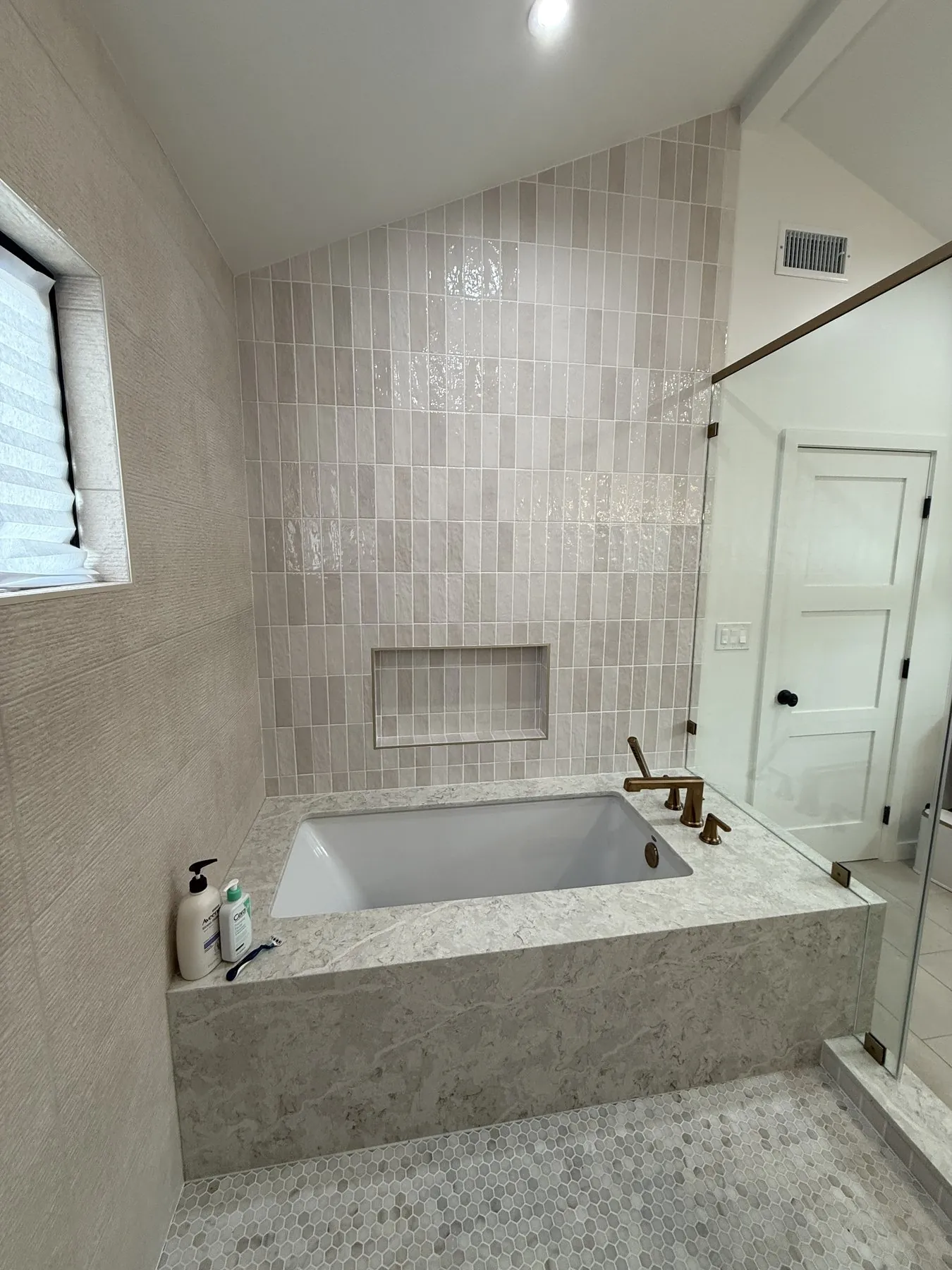
The dominant wall and floor material for 2026 is large-format porcelain, slabs as big as 4×8 feet that imitate marble, limestone, travertine, or slate. The advantages:
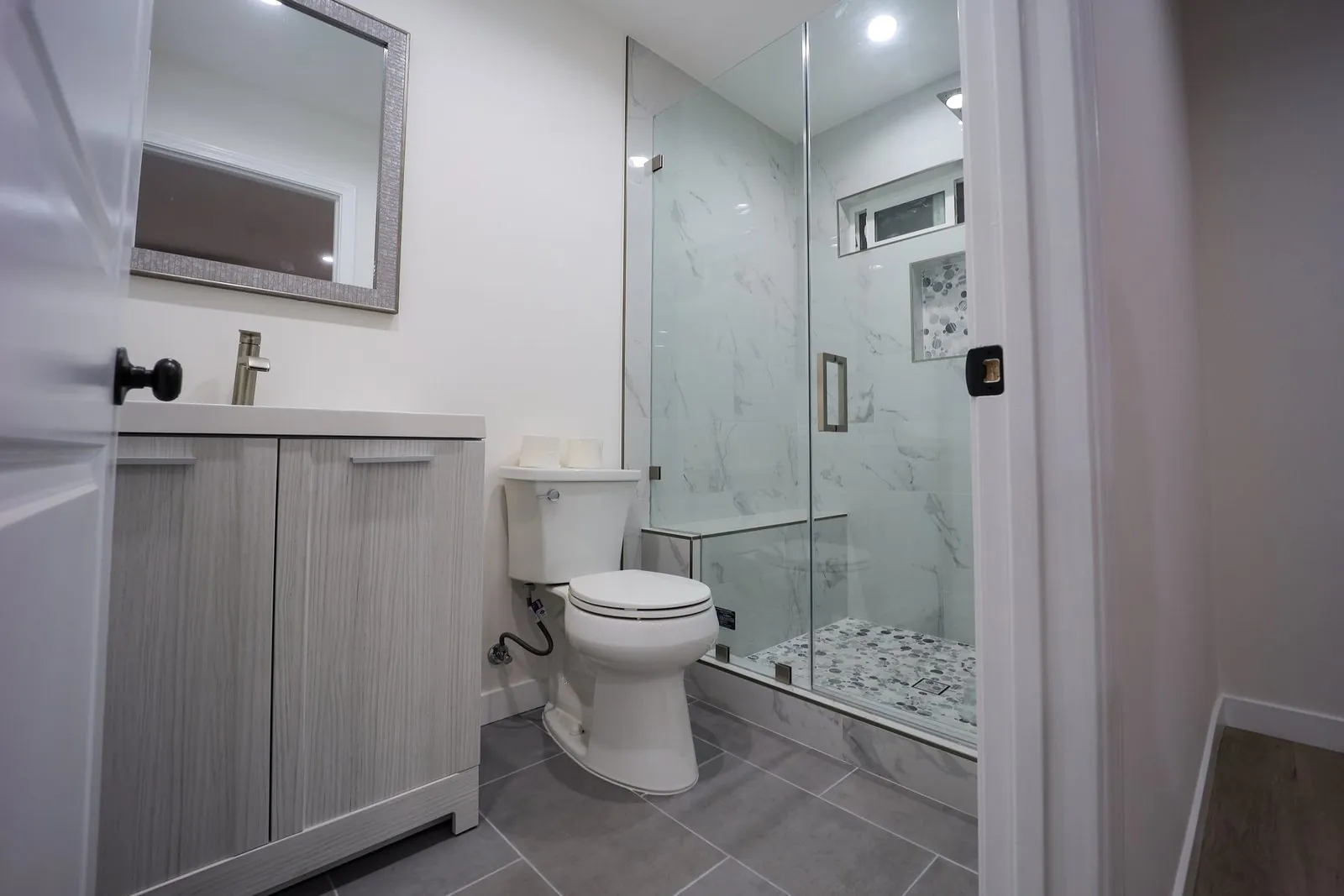
- Almost no grout lines (visually calm, easier to clean)
- Real-stone look without the maintenance
- Can be used floor to ceiling, including the shower walls
- Continuity that makes small bathrooms feel bigger
For floors, we're also seeing demand for natural materials returning: limestone, travertine, soft marble. Yes, they require sealing. Yes, they patina. That's part of the appeal, a 2026 bathroom is allowed to look lived-in.
Patterns We're Using a Lot:
- Checkerboard floors in marble or limestone, surprisingly modern when scaled big
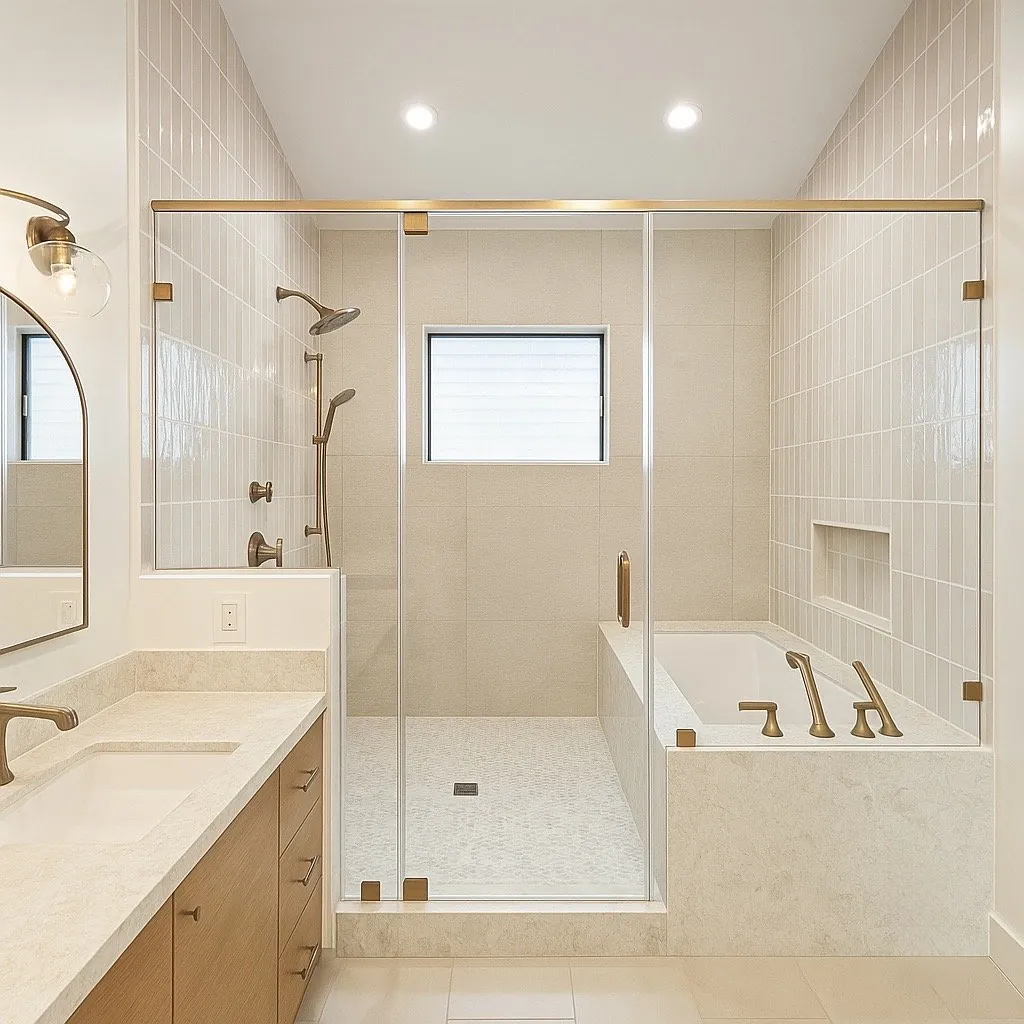
- Vertical stack for shower walls (cleaner than offset)
- Zellige in powder rooms, handmade Moroccan tile with imperfect surfaces that catch light
- Slabs as backsplashes behind the vanity, full-height
Color: Warm, Saturated, Confident
The all-white, all-grey bathroom is over. In 2026 we're using:
- Warm beiges and creams as the dominant tone
- Deep greens for vanities and powder rooms
- Inky blues and oxblood reds for small accent rooms
- Honey and amber stones for warmth
- Brushed bronze and unlacquered brass fixtures (silver and chrome are cooler)
The 2026 bathroom should feel like a place you want to spend ten minutes alone, not a hospital room with better lighting.
Lighting: Dimmable, Layered, Intentional
Bathroom lighting is one of the easiest places to get a remodel wrong. The defaults, flat overhead lighting and a vanity bar, make everyone look bad and feel worse. In 2026, we're layering:
- Backlit mirrors for soft, glow-from-within main face lighting
- Sconces flanking the vanity at face height for proper makeup lighting
- Dimmable recessed lights in the shower (waterproof) and ceiling
- A statement fixture, chandelier, large pendant, or sculptural piece, over the tub or in the center
- Toe-kick lighting under floating vanities for nighttime navigation
Every circuit on a dimmer. Separate switches for "morning" vs "evening." A nightlight setting that's amber-warm, not blue-white.
The Smart Bathroom: Less Than You'd Think
You'd expect "smart bathrooms" to dominate 2026 trend lists. They don't, really. The features we install most are quietly smart, not obviously smart:
- Heated floors with programmable thermostats
- Steam shower presets ("morning routine," "Sunday long shower")
- Built-in speakers (Sonos in-ceiling)
- Motion-activated nightlights inside the toilet bowl and under the vanity
- Pre-warming towel warmers on a timer
Smart toilets with bidet functions are also up significantly, Toto Washlet and equivalent units now show up in roughly 1 in 4 primary bathroom remodels we do.
Where to Spend, Where to Save
If you're remodeling on a budget, here's where it matters most:
- Spend on: waterproofing, plumbing rough-in, the shower, lighting, the vanity
- Save on: the toilet (any quality one is fine), trim accessories, decorative tile that you can swap later
- Don't compromise on: ventilation, drain sizing, electrical for heated floors and steam (running rough-in for these is cheap; adding later is brutal)
And, the most expensive bathroom mistake we see, don't move the toilet stack unless you have to. Moving plumbing through the slab is an enormous expense. Work with where the drain is, not where you wish it was.